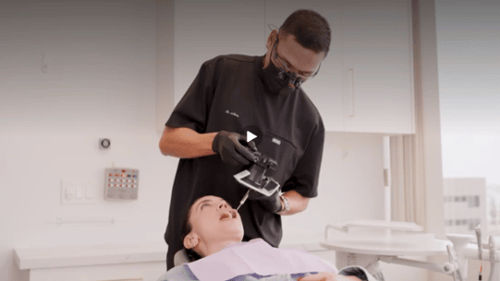
If you've had dental work done, you may know the feeling. You're numb, the procedure is underway, and then your dentist steps out to check on someone in the next room. You wait. An assistant takes over a step or two. Eventually the dentist comes back, and the appointment picks up where it left off.
That pattern has a name: double-booking, sometimes called double-stacking. At Schuster and Ochoco Dental, we don't do it. Dr. Aaron Ochoco sees one patient at a time, and it changes more than how the appointment feels. It changes how the work gets done.
What Does Double-Booking Mean at a Dental Office?
Double-booking means scheduling two or more patients in overlapping time slots, so the dentist rotates between treatment rooms during the same hour. While the dentist works in one room, assistants handle other steps in the next one, and patients often wait in the chair until the dentist returns.
It helps a practice see more patients in a day, but it can mean less of the dentist's time for each person in the chair.
What Happens During a One-Patient-at-a-Time Appointment?
Dr. Ochoco describes a restorative appointment at our practice as fundamentally different from one at an office that double-stacks patients.
"Rather than juggling multiple rooms or relying heavily on assistants, which often leads to extended wait times in the chair, I remain with the patient from start to finish," he says.
That includes the steps many offices hand off. "I perform the majority of the clinical work directly, including steps frequently delegated elsewhere, such as preparing for impressions, taking impressions, and fabricating temporary crowns."
You might expect this to make appointments longer. According to Dr. Ochoco, it does the opposite. "This results in a more time-efficient appointment for the patient," Dr. Ochoco explains, "as we can finish their procedures quicker without extended wait times and with the quality control of every step being done by the doctor."
In other words, the time other dentists spend walking between rooms is time Dr. Ochoco spends on your treatment.
What Do Patients Notice When They Switch From a Double-Booked Practice?
Dr. Ochoco hears about the difference often, especially from patients who have transferred to our office.
"Patients transferring from double-stacking practices often share that they previously felt like part of an assembly line, where doctors rushed or relied heavily on assistants," he says. "They frequently felt unheard or dismissed due to the doctor's limited availability."
That feeling has real consequences. A patient who feels rushed is less likely to mention a sensitivity, ask about an option, or share what they want their smile to look like. "In our practice, patients appreciate having dedicated time where their concerns and preferences are thoroughly heard and addressed," Dr. Ochoco says.
Which Procedures Benefit Most From a Dentist's Undivided Attention?
According to Dr. Ochoco, there's no procedure where attention matters less. "This model is vital across all procedures, from routine fillings to crown preparations and full-mouth veneer cases," he says. "A dentist managing multiple chairs simultaneously lacks the bandwidth to maintain continuous quality control at every stage."
That quality control shows up in details most patients never see but feel for years. “Undivided attention directly impacts clinical outcomes,” Dr. Ochoco says, “resulting in crowns with ideal margins and contacts, as well as fillings with proper anatomy and occlusion rather than flattened restorations.”
In plain terms, a crown’s margins are where it meets the natural tooth, and its contacts are where it touches the teeth beside it. When both are precise, the crown seals well and food doesn’t catch between teeth. A filling with proper anatomy recreates the tooth’s natural grooves and cusps, and good occlusion means it fits your bite, so it feels like part of your mouth instead of something you notice every time you chew.
Just as important is the time to listen. One-patient-at-a-time scheduling, Dr. Ochoco says, “provides the necessary time to listen attentively to patient needs without the pressure of an overextended schedule.”
One Patient at a Time vs. a Double-Booked Schedule
| One Patient at a Time | Double-Booked | |
|---|---|---|
| Who stays with you | The dentist, from start to finish | The dentist moves between rooms |
| Impressions and temporary crowns | Done by the dentist | Often delegated to assistants |
| Waiting in the chair | Minimal | Common while the dentist is with another patient |
| Quality control | The dentist checks every step | Split across multiple chairs |
| Time to talk | Built into the appointment | Limited by the next patient |
Frequently Asked Questions
Does one-patient-at-a-time scheduling mean longer appointments?
Usually not. Because Dr. Ochoco stays with you and handles most steps himself, there's no waiting while he works with someone else. Many procedures finish sooner than they would on a double-booked schedule.
Is this approach only for cosmetic treatment?
No. Dr. Ochoco schedules this way for everything from routine fillings to crowns and full veneer cases. Precision matters just as much in a small filling as it does in a smile makeover.
How can I tell if a dental office double-books?
Ask before your appointment whether the dentist will stay with you for the whole procedure, and who takes impressions and makes temporary crowns. The answers will tell you a lot about how the schedule is built.
Attention Is Part of the Treatment
The way a practice schedules its day shows up in your mouth: in how a crown fits, how a filling feels when you bite, and whether you left your appointment feeling heard. At Schuster and Ochoco Dental, seeing one patient at a time is simply how Dr. Ochoco practices, because it's how he makes sure every step is done right.
If you're ready for a different kind of dental visit, call Schuster and Ochoco Dental at (310) 453-5300 to schedule with Dr. Ochoco. We would love to welcome you to our Santa Monica office, and we proudly serve patients from Brentwood, Bel Air, Beverly Hills, and the surrounding Westside communities.